
About This Yatra
Prayag in modern-day Allahabad is believed to be the most important pilgrimage centre for Hindus. Traditionally river confluences are regarded as auspicious places, but in Sangam, the significance of the confluence is most pious because here, the confluencing holy Ganga, Yamuna and the mythical Saraswati meet to become one.
According to legends, Vishnu was carrying a Kumbh (pot) of amrit (nectar), when a scuffle broke out and four drops were spilled. They fell to earth at the four Tirthas of Prayag, Haridwar, Nasik and Ujjain. A tirtha is a place where the devout can attain salvation. The event is commemorated every three years by the Kumbh Mela, held at each tirtha in turn; the Sangam is known as Tirtharaj, the King of Tirthas and here the Kumbh is held once in every twelve years, which is the greatest and holiest of all.
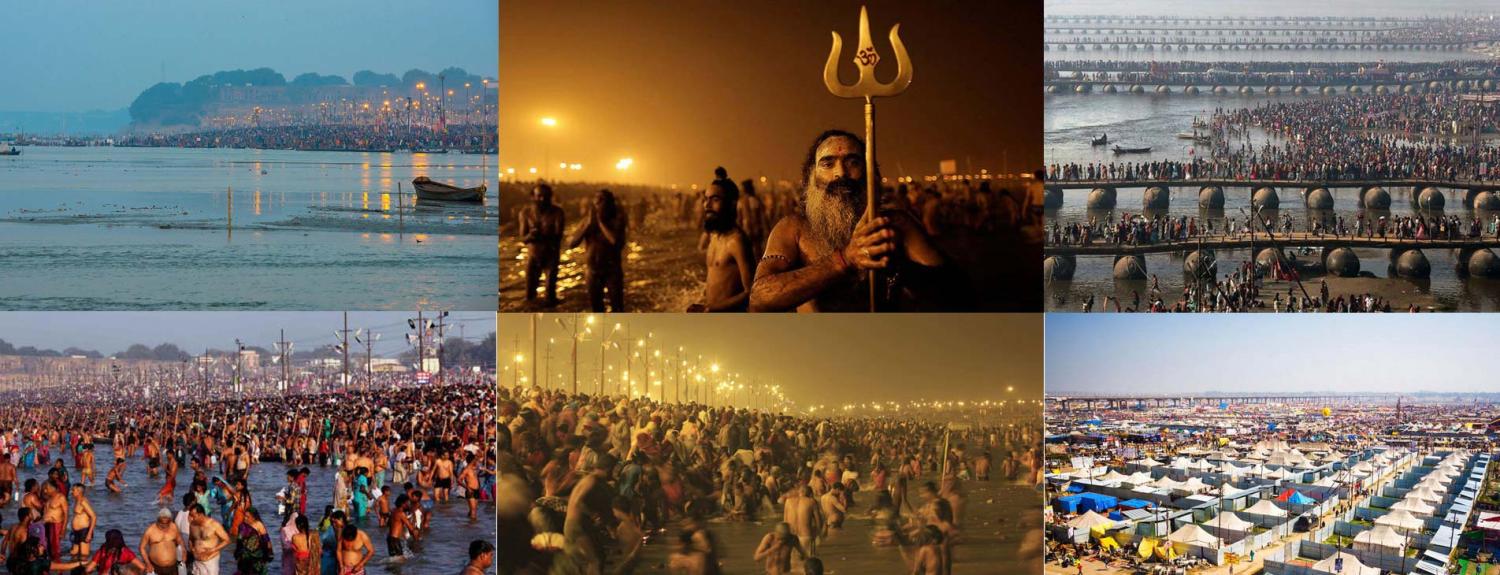
The Maha Kumbh Mela is the largest religious congregation in India, attended by millions. The over month-long fair is marked by the construction of a massive tented township, complete with cottages, huts, platforms, civic facilities, administrative and security measures. It is organized immaculately by the government, the local authorities and the police. The mela is especially renowned for the presence of an extraordinary array of religious ascetics – sadhus and mahants – enticed from remote hideaways in forests, mountains and caves. Once astrologers have determined the propitious bathing time or Kumbhayog, the first to hit the water is by legions of Naga Sadhus or Naga Babas, who cover their naked bodies with ash and wear hair in long dreadlocks. The sadhus, who see themselves as guardians of the faith, approach the confluence at the scheduled time with all the pomp and bravado of a charging army. The most recent Maha Kumbh Mela was held in 2013 and the next is due in 2025.
Sangam is the confluencing point where the brown water of the Ganga meets the green water of the Yamuna, along with the mythical Saraswati, which remains unseen but believed to run underground. It is located about 7 km from Civil Lines, overlooked by the eastern ramparts of the Akbar Fort. Wide flood plains and muddy banks protrude towards the sacred Sangam. At the mid-river point priests perch on small platforms to perform puja and assist the devout in their ritual ablutions in the shallow waters. A dip in the Sangam water is supposed to be the holiest of the holy pilgrimages for the devout Hindu. Boats to the Sangam can be rented by pilgrims and tourists alike at the ghat near the fort. It is during the Maha Kumbh/Kumbh that the Sangam truly comes alive, attracting the devout from all across the country.
Mouni Amavasya Tirtha Snana: Mauni means silence. Those who observe a vrat on this day, fast without uttering a word. And since they maintain silence, the Amavasya is also referred to as Mauni Amavasya. The Amavasya Tithi (New Moon Day) in the month of Magha is referred to as Maghi Amavasya or Mauni Amavasya. On this day, devotees take a dip in sacred rivers, and the ritual of taking a bath in the Ganga is called Ganga Snan (bath). It is believed to be one of the most auspicious days in the Hindu calendar. Mauni Amavasya's significance increases manifold during Kumbha Mela, which is believed to be the world's largest religious gatherings. And a bath in the river on special days is called Shahi Snan. Also, the month of Magha is said to be the month ideal for performing austerities and spiritual awakening. Age-old belief suggests that on Mauni Amavasya day, the Ganga water transforms into Amrit (divine nectar). Hence, Ganga Snan on Maghi (Mauni) Amavasya frees one from the outcomes of his/her wrongdoings.
Places to Visit
Kumbh Mela
The magnificent spiritual gathering drawing millions of devotees, featuring camp layouts, spiritual discourses, and bhajans.
Triveni Sangam
The confluencing point where the brown water of the Ganga meets the green water of the Yamuna, and the unseen Saraswati river.
Mouni Amavasya Tirtha Snana
The holy bath during the auspicious new moon day in Magha, when water is believed to turn into nectar.
Prayagraj & Akbar Fort
The ancient city of Prayag, containing the historic Akbar Fort and the sacred underground Patalpuri Temple.
Kashi (Varanasi)
Explore the ancient city of Varanasi, its holy ghats, and seek the blessings of Lord Vishwanath.
Yatra Highlights
Package Details
Inclusions
Extra Charges
Note: As fares and date may fluctuate depending on availability, please call the numbers below to get the most accurate price and dates.
📞 Book Your Yatra
For bookings and inquiries, please call or WhatsApp:
Life members can carry LPM (life patron cards).
Terms & Conditions
- 1 Devotees should be punctual in their reporting time and Group leaders are to ensure that others are not delayed by the delay of few devotees. Every day the Yatra will leave as scheduled and will not wait for late comers.
- 2 Devotees should stay together and not plan any thing separate from the Yatra.
- 3 All Devotees are assigned to a group leader and they should report to their group leader for all matters.
- 4 Separate timing will be given for purchases/ shopping and devotees should not go here and there for purchases.
- 5 Devotees should bring their own lock with multiple keys and the Yatra management does not hold responsibility for any loss of baggage.
- 6 Devotees should carry their essentials like medicine, water bottle, ropes for drying clothes etc.
- 7 Please carry your chanting beads and a Vaishnava song book and actively participate in kirtans.
- 8 The best way to relish the Yatra is to hear from senior devotees about the glories of the Lord and his pastimes.
- 9 Devotees are requested to carry some emergency food for old aged and children for emergency though Prasadam is arranged for all on all the Yatra days.
- 10 Devotees are suggested to carry their notebook and pen for taking notes during the Yatra.
- 11 Devotees should bring their original identity card (aadhar) and submit as and when requested.
- 12 Devotees should not offend any Dham vasis by arguing or quarrelling with them.
- 13 No one should enter a pond or a river for bathing without the permission of the group leader.
- 14 Devotees should not throw garbage and should keep the Dham clean and also keep silence.
- 15 Devotees are requested to travel light particularly those travelling by flight. The allowed baggage allowance is 15 Kgs for check in and 7 Kgs for cabin.
- 16 Please check the weather details online and carry clothes accordingly.
- 17 Devotees are requested to come in Vaishnava dress — Dhoti and Kurta for Prabhujis and Saree for Matajis during temple visits.
- 18 Devotees are requested to not carry any expensive items like jewellery, iPads etc.
- 19 Aged devotees, women and children to be given first priority and their needs to be attended on priority.
- 20 As far as possible, requesting yatris to not consume outside food.
- 21 Do not travel if there are any serious health issues.
- 22 Life members can carry LPM (life patron cards).
Information for Travellers
Ready to Embark on This Journey?
For detailed itineraries, pricing, upcoming dates, and booking information, please get in touch with us.